





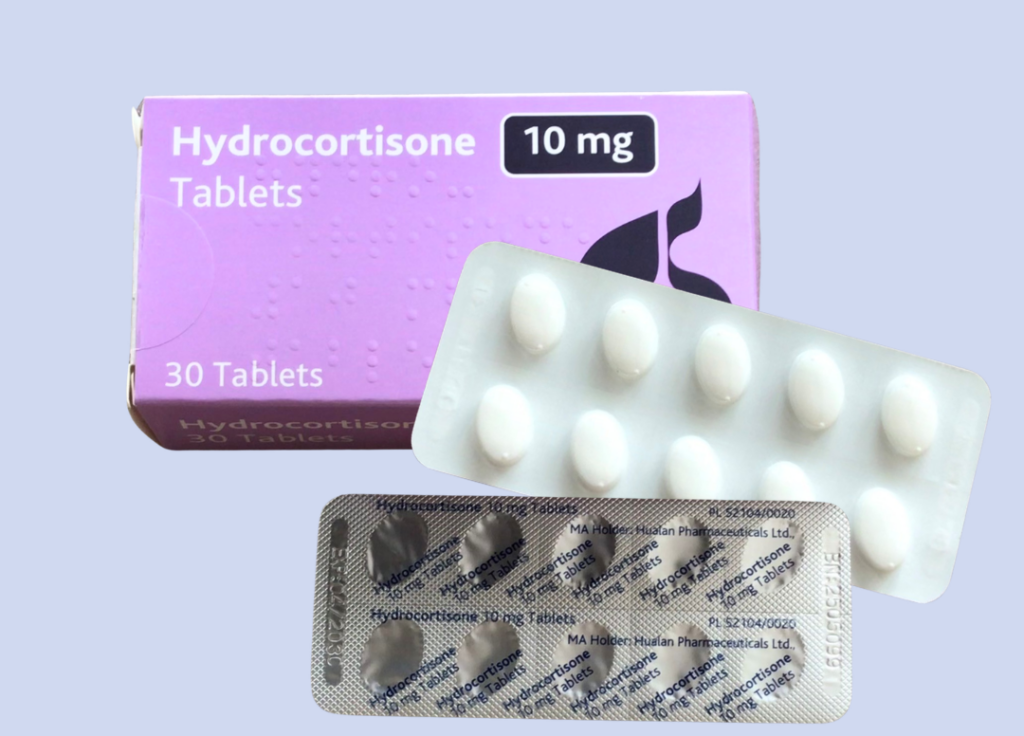
This information is for people with adrenal insufficiency who are aged 16 or over.
On this page:
- What are the steroid Sick Day Rules?
- When to follow the Sick Day Rules
- How do I increase my steroid dose when following Sick Day Rules?
- Reducing your steroid dose
- Other times when Sick Day Rules are needed
- When the Sick Day Rules might not be enough
What are the steroid Sick Day Rules?
If you have adrenal insufficiency and take replacement steroids, there may be times when you need to take more than your usual amount of steroids to stay healthy. During times of illness, injury or stress, the body needs more cortisol, so you will need to increase your steroid dose. This is called ‘updosing’.
The sick day rules give guidance on when you may need to updose, and how much extra steroids you should take.
If you have adrenal insufficiency and take replacement steroids, you should read about the sick day rules and know when to follow them. If you do not give your body enough steroids when needed, the level of cortisol in your body may drop dangerously low. This is called an adrenal crisis, and it can be life-threatening. Following the Sick Day Rules is important to prevent an adrenal crisis.
When should I follow the Sick Day Rules?

You are being sick or have diarrhoea
If you are being sick (vomiting) or have diarrhoea (but can still keep down food and drink)
You are bed-bound
You are so ill that you need to stay in bed due to weakness or illness
You have an illness that needs antibiotics
Even if you feel well, some antibiotics make steroids less effective so you should follow Sick Day Rules
You have an injury or other physical trauma
Any non-serious injuries (like a sprained ankle) mean you should follow the Sick Day Rules. Serious injuries, like a broken bone, require emergency injections.

You have a temperature over 37.5 degrees
A fever or temperature over 37.5 degrees C means you should follow Sick Day Rules.

Intense emotional stress
You should also consider following the Sick Day Rules for one or two days during periods of intense psycholgical stress
The list above is a summary of the main times when you need to updose. This is not a complete list and there may be other times you need to increase your dose. You can find out more about this below.
How do I increase my steroid dose when following Sick Day Rules?
The following doses are for a 24-hour period. These doses are guidance and some people may need more than this. It is important to listen to your body and take more steroids if you still feel you have low cortisol. Our Signs of Adrenal Crisis table can help you work out if your cortisol may be low.
If your usual dose is 10 to 25 mg:
Increase your dose to 40 mg of hydrocortisone a day. You should split this into two to four doses, taken throughout the day.
Start by taking 20 mg immediately.
If your usual dose is 25 mg or more:
Double your usual dose and take this in two to four doses, split throughout the day.
Start by taking 20 mg immediately.
If your usual dose is 3 to 10 mg:
Take at least 10 mg, in one or two doses.
Start by taking 5 mg immediately.
If your usual dose is more than 10 mg:
Continue with your usual dose, taken in 2 doses throughout the day.
Switch to regular hydrocortisone and take at least 40 mg in 24 hours, split over 4 doses.
How long should I increase my steroid dose for?
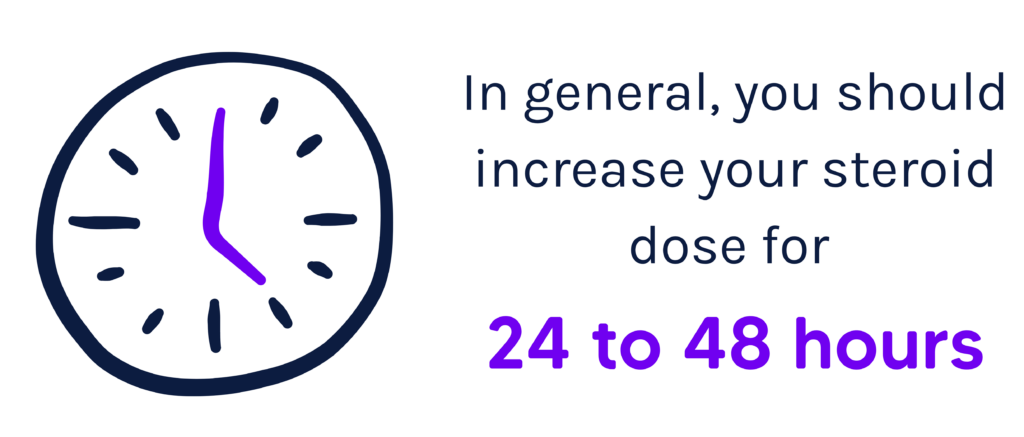
In most cases, you should updose your steroids for 24 to 48 hours, depending on how you feel. Once you start to feel better, you can gradually return to your normal dose. If you are still unwell after 48 hours, you should speak to your GP or endocrine team.
If you are taking antibiotics, you should updose for as long as you are taking them.
Reducing your steroid dose
When returning to your normal steroid dose, you should do this gradually. You should not go from an increased dose back to your normal dose in one go.
For example, this may look like reducing your hydrocortisone dose by 5 mg each day, until you are back to your usual dose. Prednisolone may take longer to wean off from higher doses.
If you start to feel unwell again while reducing your dose, you should increase your dose again and seek medical advice.
You should not take increased doses of steroids for too long. Taking too many steroids for a long time can be bad for your health. You should return to your normal dose when you feel able to. You can read more about this here.
Speak to your GP or endocrine team for more support on reducing your doses.
Things to remember:
1. Do not reduce your steroid dose in one go. Reduce slowly over a number of days
2. If you feel unwell after reducing your dose, increase your dose again and seek medical help
3. Prednisolone may take longer to wean off from than hydrocortisone
Are there other times when I should follow the Sick Day Rules?
As well as the situations listed above, there are other times when you may need to increase your steroid doses. The table below covers more illnesses or situations where the sick day rules should be followed.
Click here to download this table as a PDF.
How to updose for illness or injury
| Illness or situation | What to do | further actions |
| Adrenal crisis (click here for signs of adrenal crisis) | Follow steps for adrenal crisis. Click here to find out more. | Call ambulance and go to hospital straight away |
| Infection with high temperature (e.g., UTI, chest infection, tonsillitis) Not everyone with an infection will have a high temperature. If there is a clear sign of infection then follow Sick Day Rules. If you are not sure, as your GP or endo team. | Follow sick day rules dosing. Continue for two days, or until you feel better. | If your symptoms are not better after two days then speak to your GP. You may need antibiotics. If you start to feel worse, call 111 or 999. |
| Antibiotic treatment for infections This does not include prophylactic or preventative use. | Follow Sick Day Rules dosing. Continue throughout the course of antibiotics (usually 5 to 7 days). If you have a minor infection (like a skin infection) and you feel well, then you may not need to updose. Check this with your GP or endo team though, as some antibiotics make steroids less effective. | If your symptoms have not gone after finishing antibiotics, speak to your GP. If you feel worse, call 111. |
| Being sick (vomiting) | If you are still able to eat and drink, then follow the sick day rules for 24 to 48 hours, or until you feel better. If you vomit within 30 minutes of taking your steroid dose, you should take it again at double the original dose. If you vomit again within 30 minutes, use your emergency injection and go to hospital. | If you have ongoing vomiting, this can make it hard for your body to absorb your steroids. You may need to be treated in hospital if this happens. |
| Loose watery poo (diarhhoea) | Follow the sick day rules for 24 48 hours, or until you feel better. If you have severe diarrhoea (3 or more instances in a day), and you feel sick or weak, use the emergency injection and seek medical help. | If diarrhoea is not severe then this is okay to manage at home. Stay hydrated and speak to your GP or 111. If you have ongoing diarrhoea, this can make it hard for your body to absorb your steroids. You may need to be treated in hospital if this happens. |
| Physical injury (more than minor), e.g., injured toe, finger, hand etc | Follow Sick Day Rules. If your injury is significant, like a broken bone or head injury, then this may trigger an adrenal crisis. In this case, you should follow steps for adrenal crisis. | If your injury is not severe, then manage at home with your GP. If it is severe, like a broken bone, then follow steps for adrenal crisis. |
| Long flight over 12 hours | Follow sick day rules dosing for 24 hours. Take your first increased dose one hour before the flight. If on prednisolone, take 10 mg one hour before the flight. Gradually reduce back to normal dose after 24 hours. | Follow good self-care steps to look after yourself, such as getting enough sleep, eating well and drinking enough water. |
How to updose for emotional stress and strain
| illness or situation | what to do | further actions |
| Severe emotional distress This may include experiencing shock, bereavement, a road accident etc. | If you feel you need to, follow sick day rules dosing. Sometimes, severe shock (like the death of a family member) can trigger adrenal crisis. If this happens, follow the steps for adrenal crisis. | Speak to your GP or endocrine team for further information, and follow the sick day rules as needed. Follow steps for adrenal crisis if needed. |
| Severe mental health crisis, such as a psychotic episode | Follow sick day rules dosing. An emergency injection may be needed here if you are very unwell and not able to take tablets regularly. Usually this would be done by a healthcare professional. | Also seek further care through GP, NHS 111 or A&E. |
| General stress, such as work or exam stress | Normally, you should not need to increase steroid doses for general life stresses. However, it is important to listen to your body and increase your steroid doses if you feel the need to. You can speak to your endocrine team or GP if you are not sure what to do. You can also call our Nurse Helpline. | Good self-care and stress management can help here. Make sure to get enough sleep, eat well and drink lots of water. |
How to updose for dental work
| illness or situation | what to do | further actions |
| Major dental surgery that needs anaesthetic. This could include extractions or procedures that need local or general anaesthetic | Use your emergency injection 30 minutes before starting general anaesthetic. For local anaesthetic, follow Sick Day Rules dosing. Follow Sick Day Rules dosing for 24 hours afterwards, before returning to your normal dose. | Before the procedure, tell your dental team about your adrenal insufficiency and need for replacement steroids. You should also tell them about the signs of adrenal crisis and how to manage this. Your dental team will monitor you throughout. |
| Minor dental surgery, such as a root canal | Follow sick day rules dosing. Take your first increased dose one hour before the surgery then continue for 24 hours. If on prednisolone, take your usual dose in the morning, and take 10 mg one hour before the surgery. | Your dental team will watch you throughout to check for signs of adrenal crisis. If you have any problems after the surgery, speak to your GP or dentist and follow sick day rules if needed. |
| Minor dental procedures, such as cleaning, scale and polish or fillings | If on hydrocortisone, take a 20 mg dose one hour before the procedure. If on prednisolone, take your usual dose in the morning then take 10 mg one hour before the procedure. Go back to normal dosing the next day. | If you have any problems after the procedure then speak to your GP or dentist. Follow sick day rules dosing if needed. |
How to updose for surgery
If you are having major surgery that needs general or local anaesthetic, then you may need to have intravenous (IV) hydrocortisone given to you whilst you are in hospital. Your healthcare team will take care of this for you. You may also need to increase your steroid dosing for a few days afterwards.
The table below has more information on how to updose for surgery. Before any surgery, you should talk about your steroid medication with your surgeon and healthcare team. It may also help to show them this table.
| situation | what to do |
| Major surgery with long recovery. For example, heart surgery, bowel surgery, kidney surgery etc | Have 100 mg IV hydrocortisone at the same time as the anaesthetic. Your healthcare team will do this for you. After the surgery, your healthcare team will give you IV hydrocortisone until you are well enough to eat or drink. (This will either be given as 100 mg IV every 6 hours, or 200 mg IV given continuously over 24 hours). Once you are able to eat and drink normally, you will go back to tablet steroids. At this point, you should follow sick day rules dosing and gradually decrease this over the next 48 – 72 hours. |
| Major surgery with shorter recovery, such as joint replacement | Same as above |
| Minor day-case surgery with general anaesthetic. For example, hernia etc | Have 100 mg IV hydrocortisone at the same time as the anaesthetic. Your healthcare team will do this for you. Then have 10 mg oral hydrocortisone every 6 hours, for 24 to 48 hours. |
| Minor surgery with local anaesthetic, such as mole removal or cataract surgery | Take 20 mg oral hydrocortisone one hour beforehand. If taking prednisolone, have your usual dose in the morning. Then take 10 mg one hour before the surgery. Return to normal dosing the next day. |
| Colonoscopy or barium enema | From the start of any pre-procedure prep, take 20 mg hydrocortisone three times a day Take 20 mg hydrocortisone three times a day, throughout any pre-procedure prep. Bowel prep may lower how much steroids you absorb. If you feel unwell you should go to hospital, as you may need IV steroids. For colonoscopies: Take your steroid dose the morning of your procedure. Remember, you are still following sick day rules at this point so this should be an increased dose. In some cases, you may go into hospital the night before. This is so you can have your bowel prep and steroids under the care of your healthcare team. You will usually have 100 mg of hydrocortisone given by IV before the colonoscopy. Your healthcare team will do this for you. You can use a 100 mg hydrocortisone injection instead of an IV. This will need to be taken 30 minutes before the procedure. Following the colonoscopy, if you are eating and drinking normally you can gradually return to your normal steroid dose. |
| Gastroscopy (also known as an upper endoscopy) or cystoscopy | You will usually have 100 mg of hydrocortisone given by IV before the procedure. Your healthcare team will do this for you. You can use a 100 mg hydrocortisone injection instead of an IV. This will need to be taken 30 minutes before the procedure. Following the colonoscopy, if you are eating and drinking normally you can gradually return to your normal steroid dose. |
How to updose for pregnancy
It is important to keep taking your steroid replacements during pregnancy. If you are planning to become pregnant, or are pregnant, speak to your endocrine team and GP about this.
You should also let your pregnancy specialist (obstetrics) know that you are steroid-dependant.
| situation | what to do |
| First and second trimester of pregnancy | Follow your normal steroid dosing. Follow sick day rules as normal, if needed. |
| If you have a fever, infection or injury whilst pregnant | Take 20 mg of hydrocortisone straight away, then follow sick day rules dosing as normal |
| Short-term vomiting from morning sickness or other illnesses | Take 20 mg of hydrocortisone straight away, then follow sick day rules dosing as normal. If you have mild vomiting and morning sickness that lasts for a long time: Keep trying to take your steroid replacements when you do not feel sick Talk to your GP, endocrine team or pregnancy team |
| Severe morning sickness with severe vomiting (known as hyperemesis gravidarum) | If you have hyperemesis gravidarum, use your emergency injection and go to hospital, or the early pregnancy unit. Hyperemesis gravidarum needs to be managed in a hospital, in an inpatient setting. For information on what treatment you will have in hospital, see our Information for healthcare professionals page. After you leave hospital, follow sick day rules dosing until daily vomiting stops |
| 3rd trimester | You may need to increase your steroid dose, depending on things like symptoms, blood pressure, blood sodium levels etc. You should talk to your endocrine and obstetrics team about this. |
| After the birth | Follow sick day rules dosing for 48 hours after your birth, then return to your normal dose. If you increased your steroid dosing during your third trimester, you should gradually return to your pre-pregnancy doses 48 hours after the birth. |
When following the Sick Day Rules might not be enough
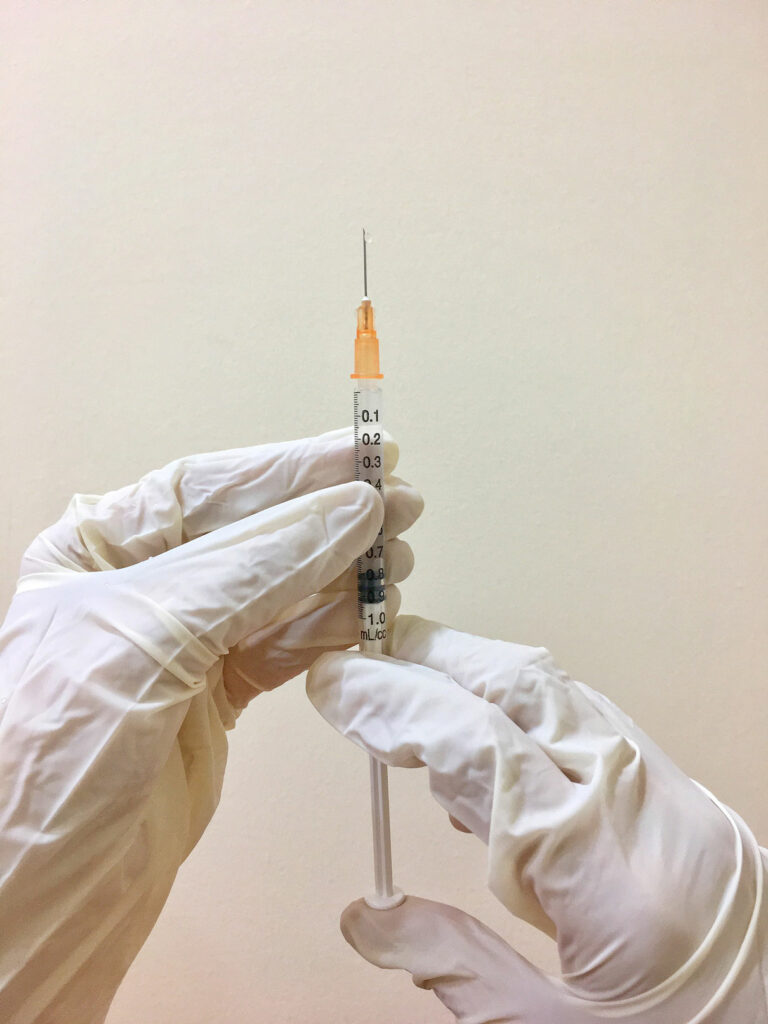
In some situations, taking extra steroid tablets may not be enough and you should use your emergency hydrocortisone injection to prevent an adrenal crisis.
This includes:
If you vomit within 30 minutes of taking your steroid tablets, you should take the same dose again, with an added extra dose. If you then vomit after this, you need to use your emergency injection.

If you have a serious injury, like a broken bone, you should use your emergency injection.
Knowing the signs of low cortisol
It’s important to know the signs of low cortisol and to recognise when your cortisol levels may be dropping. This can feel different for everyone, so knowing your own body and your own signs is important. Increasing your steroid dose when this happens can help prevent you from going into a full adrenal crisis.
It’s also important to know that your cortisol can still get too low even when you are updosing. If you have increased your dose but you start to feel worse and like your cortisol may be dropping, you should take more steroids. Our Signs of Adrenal Crisis table can help you work out if your cortisol levels are dropping too low.
Remember: if taking more steroids by mouth isn’t working, or you are in doubt, you should use your emergency injection. Injecting hydrocortisone will not harm you, but not injecting when you need it can be life-threatening.
Our emergency information page tells you how to use your emergency injection. You should always seek medical advice if you have had to use your injection or if updosing is not making you feel better.
Common questions
The sick day rules dosing is just guidance and might not be right for everyone. It is important to listen to your body and look out for the signs that your cortisol is still too low. Our Adrenal Crisis Signs Table can help you work out if you have signs of low cortisol.
If you think your cortisol is still too low after following sick day rules, you should take some more hydrocortisone to help you feel better.
It is also important to do other things to look after yourself and help you recover from illness. this includes resting, using over the counter pain relief, taking antibiotics as prescribed, eating well and drinking enough water.
It is important to make sure you take enough replacement steroids to help you stay healthy and avoid an adrenal crisis. Make sure to take the doses prescribed by your endocrinologist and follow the sick day rules when you are ill, stressed or injured.
Signs that you may not be taking enough daily steroid replacement include:
- Weight loss
- Feeling full easily
- Not feeling very hungry
- Feeling sick (nausea)
- Feeling so tired that you find it difficult to do your daily activities
- Muscle weakness
If you are worried that your daily dose of steroids is not enough, you should speak to your endocrinologist.
Taking too much replacement steroids over a long time can be bad for your health. It can be tempting to take more replacement steroids, to help with fatigue and other symptoms, but over time this could make you feel worse.
Signs that you may be taking too much replacement steroids include:
- Weight gain
- Feeling more hungry than normal
- Difficulty sleeping
- Skin thinning
- New or worsening diabetes
- New or worsening high blood pressure (hypertension)
- Cushingoid appearance
- Skin infections
- Acne
- Yeast infections (thrush)
- Breaking bones easily. This may happen from small accidents, such as a minor fall
- Height loss
It is important to understand and listen to your body in preparation to take on these challenges. Take breaks, hydrate and if you feel you cannot do more, stop. Up-dosing is in times of illness or unprecedented stresses. Keep enough steroids with you for the day incase of needing to updose.
When taking on big physical challenges, is important to understand your body and listen to how you feel. Take breaks, hydrate, eat enough and if you feel you cannot do more, stop. Updosing is needed for times of illness or unprecendented stress. You should keep enough steroids with you for the day in case you do need to updose.
It is not recommended to increase steroid doses just because of hot weather. However, hot weather can cause illnesses that mean you should follow Sick Day Rules, like heat-stroke. Hot weather also puts more strain on the body, so it is even more important to follow Sick Day Rules if you are ill or injured in hot weather.
You can read more about this on our heatwave guidance information page.
Yes. If you have had to use your emergency injection, then you should still go to the hospital even if you feel better. You may need more hydrocortisone once the injection wears off. You may also need to have IV fluids.
Extra dosing may be needed if there is a time difference and you are continuing activities of daily living beyond normal waking hours. If staying up late, perhaps the days dose can be shifted further along the day i.e. an hour later or split up that day e.g instead of taking 5 mg at 4pm you could take 2.5 mg at 4pm and a further 2.5 mg at 7pm.
Normally, this isn’t necessary, although it is important to understand your pain threshold and the duration of the procedure. You should have extra steroids and your emergency injection with you just in case, and explain your condition to the people around you.
Yes, you can use an out-of-date injection if you need to. You should always use in-date medication where possible, but if you only have an out-of-date injection available it is better to use this than to not.
Make sure to regularly check your medication expiry dates and replace any that are out of date.
You should speak to your endocrinologist before fasting, to see if it is safe for you to do so. While fasting, you may need to swap to a once-daily, long-acting steroid (like prednisolone), to take at dawn (suhoor).
For more information on fasting with adrenal insufficiency, see our ‘Fasting with adrenal insufficiency leaflet’.
Both AVP deficiency and an adrenal crisis can cause hyponatraemia (low sodium). Symptoms of this will be similar, such as headache, nausea, vomiting and confusion. If you have both AVP deficiency and adrenal insufficiency, it is very important you are seen by an endocrinologist if you go to hospital with low / high sodium, or an adrenal crisis.
Medical words explained
- Oral – a medication that you take by mouth, in this case a tablet
- Intravenous (IV) – medication that is given into your vein. This is usually done by an IV drip in hospital
- Intramuscular (IM) – medication that is injected into your muscle. An emergency hydrocortisone injection is an example of an intramuscular injection
- Updose – increasing your steroid dose to follow the Sick Day Rules
- Prophylactic – When antibiotics are given to prevent an infection, rather than treat one
- Anaesthetic – medication given to you before surgery or another procedure to numb pain or put you to sleep
- Colonoscopy – a procedure that uses a small camera to look at the inside of your bowels
- Barium enema – an X-ray to look at your intestines
- Gastroscopy – a procedure where a small camera is used to look inside your stomach
- Cystoscopy – a procedure that uses a small camera to look into your bladder
- Obstetrics – the area of medicine that deals with pregnancy
Where to find more information
- Adrenal crisis emergency information
- Adrenal crisis action plan
- Fasting with AI leaflet
- NICE NG243 guidelines: Treatment and management of adrenal insufficiency
References
- https://pubmed.ncbi.nlm.nih.gov/32419166/
- https://www.endocrinology.org/media/4169/ai-and-exogenous-steroids_patient-information-sheet.pdf
- https://www.addisonsdisease.org.uk/newly-diagnosed-sick-day-rules
- https://www.nice.org.uk/guidance/ng243/chapter/recommendations#people-aged-16-and-over
This information was last updated in September 2026.

We're on a mission to help everyone with a pituitary condition to live well. Your donation can make this happen.
If you believe in this mission too, please donate today.