





The future of cortisol testing
We recently welcomed Professor Miguel Debono, consultant endocrinologist and clinical director of diabetes and endocrinology at Sheffield Teaching Hospitals, to discuss his research into the use of saliva rather than blood in cortisol testing.
Why do we test cortisol?
Cortisol is tested when there is a suspicion someone is producing too much or too little cortisol. When low cortisol is suspected, cortisol will be measured at the peak of natural cortisol production, usually first thing in the morning. When high cortisol is suspected, cortisol may be measured at night, as this is the lowest point of natural cortisol production.
The most common method for testing cortisol is a blood (serum) cortisol test. This test takes place in the morning in hospital.
Professor Debono’s research instead makes a clinical case for the use of saliva as a method for testing cortisol.
Advantages of salivary cortisone testing
The salivary cortisone test takes place at home and patients will provide their own saliva sample. This is a much less invasive approach to traditional blood tests, with no needles involved.
To take a saliva test using a salivette, adult patients will chew a swab for around a minute, then package up the swab and return this to the endocrine clinic by post. The test can stay stable for up to five days, meaning the results will still be accurate when they reach the clinic even if there are some delays in the post.
The saliva test takes place in familiar surroundings and avoids the additional stress of being in a hospital environment. The stress of travelling to and being in hospital can cause higher stress levels in many people, which can affect the results of a cortisol tests. 80% of patients in Professor Debono’s clinic preferred taking the test at home.
The salivary cortisone test is very low cost. The hospital-based blood test costs around £398 per test, whereas the postal saliva test costs £20 per test. The deduction in cost could see estimated national savings of £24 million per year.
The deduction in cost could see estimated national savings of £24 million per year.
Why does spit work as well as blood?
The results of salivary cortisone tests are very accurate. In a recent study, Professor Debono identified 115 patients without adrenal insufficiency and 89 with adrenal insufficiency using saliva cortisone tests. These patients had participated in the previous NIHR-funded diagnostic accuracy study in 2020. Five years later, none of the 115 patients without adrenal insufficiency had developed adrenal insufficiency, showing the test was accurate initially.
Saliva cortisone testing can also be used to detect too much cortisol and diagnose Cushing’s disease. Using late night at home testing, the saliva cortisone test was 100% sensitive.
Using late night at home testing, the saliva cortisone test was 100% sensitive.

By loading the video, you agree to YouTube’s privacy policy.
Learn more
Key takeaways:
- Patients with pituitary lesions are at risk of developing adrenal insufficiency and should be screened
- Waking salivary cortisone is an accurate, evidence-based screening test for adrenal insufficiency
- Midnight saliva testing also helps screen for Cushing's disease, and to check for its return after treatment.
- Home saliva testing is cheaper than hospital testing and patients consistently prefer it.

Questions from the audience
Could saliva cortisol or cortisone testing be used to help optimise the timing of hydrocortisone replacement therapy?
Yes. Here's a more cohesive and logically ordered set of questions that you could ask an endocrinologist or researcher: In most circumstances we would not usually recommend measuring cortisol to optimise hydrocortisone replacement treatment but if needed saliva cortisone not cortisol can be used.
Could saliva cortisol or cortisone testing eventually be introduced in GP care to help identify possible endocrine disorders earlier, before referral to an endocrinologist?
Yes, eventually when resources are available GPs will be able to request this test to help identify endocrine disorders.
If testing is currently limited to specialist laboratories, how likely is it that saliva cortisone testing will become more widely available across NHS hospitals in the future?
At present, NHS trusts can request waking salivary cortisone testing and send samples to a central laboratory for analysis. Over time, individual trusts may establish their own local laboratory assays for measuring cortisone in saliva, provided they are satisfied that the analytical method is sufficiently accurate, reliable and cost-effective. This approach would allow trusts to develop local testing capacity while maintaining appropriate standards of quality and clinical governance.
More broadly, how do you see saliva-based testing changing the diagnosis and management of adrenal and pituitary disorders over the next 5 to 10 years?
We are currently undertaking an NIHR-funded Health and Social Care Delivery Research study to establish the processes required to implement waking salivary cortisone testing across NHS trusts. The findings will provide a practical framework that can be used by NHS trusts to establish saliva testing pathways for the investigation of adrenal and pituitary disorders. Given that saliva testing for cortisone is accurate, offers significant benefits to patients, and has the potential to reduce healthcare costs, we anticipate that its use will become increasingly widespread across the NHS over the coming years.
People with adrenal insufficiency face life-threatening emergencies called adrenal crises, which need urgent treatment with hydrocortisone injections. In this study, 12 people shared their struggles of managing their AI and adrenal crises, which included complex injection procedures, severe symptoms which made self-injection challenging, and limited support to manage these crises effectively.
The study identified several areas that would help people to self-manage their AI better. This included:
- Simpler injection devices
- Better information
- Improved training for healthcare staff
Implementing these suggestions would help prevent avoidable hospital admissions and save lives.
Click here to read the full article. This article was written by Aldons Chua, an Endocrine Specialist Nurse and a member of our staff team.
For more information on what to do in an emergency adrenal crisis situation, please see our Emergency Info for AI and AVP-D page.
‘Hypotonic polyuria’ is when you produce large amounts of dilute urine and is a symptom of three possible endocrine conditions:
- AVP deficiency (AVP-D, previously known as central diabetes insipidus)
- AVP resistance (AVP-R, previously known as nephrogenic diabetes insipidus)
- Primary polydipsia (PP)
Finding out which condition is responsible for causing hypotonic polyuria and subsequently managing this condition can pose challenges for clinicians. There have been advances in diagnostic techniques in recent years and it is becoming more common that clinicians will use a technique called ‘copeptin measurement’ to investigate the root cause of hypotonic polyuria.
A recent research article, co-authored by Deborah Cooper (a Pituitary Foundation Trustee), Professor John Wass, and Professor Miles Levy (members of our Medical Committee) looks at three different patient cases where copeptin measurement was used to diagnose an endocrine condition. These cases highlight how copeptin measurement can be a better diagnostic tool than other techniques, such as the water deprivation test. In this blog post, we explore what copeptin is, how it can be used for diagnosis and why it may be preferred over other techniques, such as the water deprivation test.
What is copeptin and how can it be used to diagnose endocrine conditions like AVP-D?
Arginine vasopressin (AVP) is a protein made in the body using many smaller protein building blocks. Its normal function is to prevent the passing of excessive amounts of urine. If there are issues in the production or function of this protein, it can lead to AVP deficiency.
One of the protein building blocks used to make AVP is a small protein called copeptin. Copeptin is released in the body proportionately to AVP, meaning that the amount of copeptin in the blood mirrors the amount of AVP. As copeptin is easier to test for in blood, this makes it a good way to assess how much AVP the body is producing. If there is a low level of copeptin in the blood this would also mean there is also a low level of AVP. Therefore, measuring copeptin can be used to help diagnose AVP-D, AVP-R or primary polydipsia (PP).
Why can’t we measure AVP instead of copeptin?
It can be very difficult to accurately measure the amount of AVP in the blood, for different reasons:
- AVP in samples breaks down quickly, making it hard to measure accurately once the sample is taken. Copeptin is more stable than AVP, meaning it takes longer to break down and therefore is easier to measure accurately
- There are not many tests available to measure AVP and the ones available take a long time to give results
- A large amount of AVP in the blood is not detected by tests, which can give incorrect readings
Why might measuring copeptin be better than a water deprivation test?
Anyone who has experienced a water deprivation test will be aware of how uncomfortable they can be. The test usually involves stopping someone from drinking water, usually for up to 8 hours but sometimes for longer. This is to assess how concentrated their urine becomes.
As well as being very uncomfortable, a water deprivation test may also not have complete accuracy when being used to differentiate between whether someone has AVP-D or PP. Also, if a patient has PP then there may be very large amounts of water in their system from having drunk so much. This means it can take even longer for them to become dehydrated for this test, which can be very uncomfortable.
What type of diagnostic test is right for you?
Your GP or endocrinologist will choose the right diagnostic tests for you based on your symptoms and medical history. Your clinician will also assess your fluid intake and output over 24 hours, for a couple of days.
Copeptin tests are currently used by the NHS and it is possible that patients may be able to request a certain diagnostic test, although it will depend on other factors (as mentioned above) as to whether certain tests can be used or not.
Overall, using copeptin levels to diagnose vasopressin-related endocrine disorders can provide more accurate and timely diagnoses, which can help ensure that patients receive appropriate care and management of their symptoms. Historically, these conditions have proved difficult to diagnose so hopefully advancements in diagnostic processes will mean that endocrinologists will be better able to diagnose and manage these conditions.
You can read the full article here. You can also find out more about AVP-D and AVP-R, including diagnosis and treatment of these conditions.
References
- Approach to the patient with suspected hypotonic polyuria; JCEM; 2025;110(2);
- Copeptin and its role in the diagnosis of diabetes insipidus and the syndrome of inappropriate antidiuresis; Clin Endocrinol (Oxf). 2019;91(1):22–32;
- The emerging role of copeptin; Clin Biochem Rev. 2021;42(1):17–25
Deciding where to focus research efforts for health conditions and their treatment is an important part of conducting new research. One challenge of this is that the priorities for what research to carry out do not always align with the needs and priorities of patients.
In 2023, we shared an opportunity to be involved in research aimed at setting out future priorities for pituitary adenoma surgery. We are now happy to say that this research has been completed and the findings are ready to share with the community! We want to thank anyone who put themselves forward to be involved in this research; the findings will surely be of great importance in helping to address patient priorities and improve outcomes in the future.
Research overview and findings
A number of years ago, a group of researchers came together to carry out an international study called PitCOP (Pituitary Surgery Core Outcomes and Priorities). This study aimed to establish what the top 10 priorities should be for research around pituitary adenoma surgery. This study actively sought to include input from patients and healthcare workers, to ensure that the findings represent researchers and clinicians, as well as the patient community that they seek to support.
The study was led by:
- Hani Marcus, Consultant Neurosurgeon at University College London Hospitals (UCLH) and University College London (UCL)
- Angelos Kolias, Consultant Neurosurgeon at the University of Cambridge and Cambridge University Hospitals
- Stephanie Baldeweg, Consultant Endocrinologist at UCLH and UCL, Chair of our Medical Committee and member of our board of trustees
The researchers collected over 300 responses from people affected by pituitary tumours and healthcare professionals across 17 countries. The key themes emerging from the research include:
- Improving diagnosis and management to avoid delays
- Advancing surgical techniques and technologies
- Improving patient support and follow-up
- Optimising the prediction of outcomes and complications
We are very proud of having completed the first ever international study on setting research priorities in pituitary surgery. In my role as consultant endocrinologist and as a trustee and chair of clinical committee of The Pituitary Foundation, the UK national pituitary charity, I am acutely aware that we can achieve most when patients and clinicians work closely together. I am convinced that our study will lead to more patient centred pituitary research. - Prof Stephanie Baldeweg
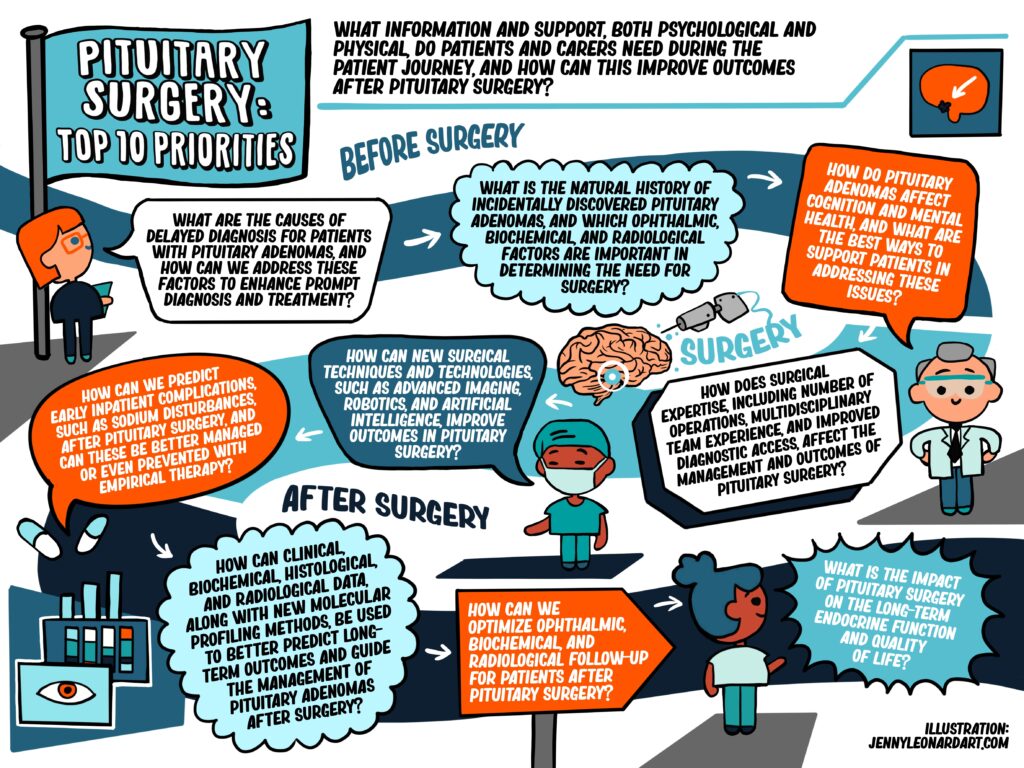
To know more, you can read the full research article. The researchers also created a visual infographic that outlines the key findings from the research and how they relate to each stage of the patient journey, from pre-surgery through to post-op and long-term endocrine management. You can view this below.
This month, some of the team attended the Society for Endocrinology BES conference, being held in Harrogate from March 10th to 12th. The team were joined and supported by Anita, a fantastic volunteer who helped set up and oversee the stand throughout the event.

Throughout the conference, we were able to meet lots of brilliant endocrine clinicians working across the UK and were able to tell them more about what we do as a charity and how we can support their patients. We also had lots of publications and information available from our stand that proved very popular with the healthcare professionals!
On the final day, we also attended a talk delivered by Rosalind Way, a member of our Lived Experience Committee. In her talk, Roz discussed her experience of living with acromegaly and the role of The Foundation in supporting those living with pituitary conditions.

Congratulations to Prof Stephanie Baldeweg, Chair of our Medical Committee and Trustee, who was awarded the British Society for Endocrinology Outstanding Clinical Practitioner Award, at the conference! Prof Baldeweg received this award for her significant contribution to the endocrine community and for showing commitment to developing and delivering innovative endocrine care for the benefit of patients.

Overall it was a very informative and successful conference and was a great opportunity for the team to keep up to date with recent research in the endocrinology landscape. We look forward to attending future endocrinology conferences!