





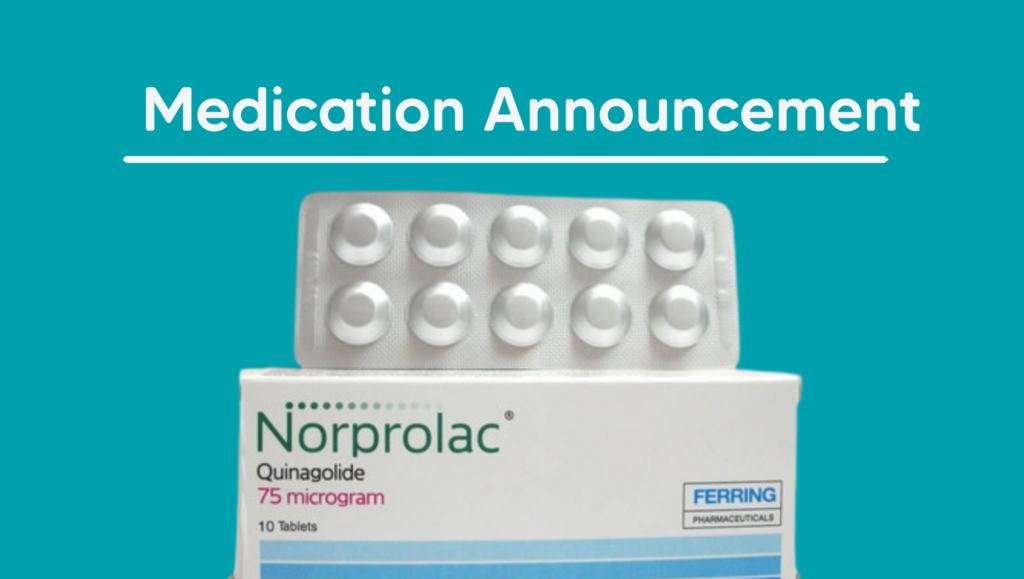
The Department of Health and Social Care has recently announced that quinagolide (also called Norprolac®) has been discontinued. Quinagolide is available as three different tablet formulas: 25, 50 and 75 micrograms. All of these tablet forms are now discontinued and will no longer be available in the UK.
The 25 and 50 microgram tablets were discontinued in February 2026, and the 75 microgram tablets have recently also been discontinued. Remaining supplies of the 75 microgram tablets are expected to run out by December 2026
What does this mean?
As these tablets are now discontinued, this means they will no longer be available in the UK. Anyone newly diagnosed with a pituitary condition that may have previously been treated with quinagolide will now be prescribed alternative medications. Anyone who currently takes quinagolide will need to move to a different medication. For most people, this will mean moving to either bromocriptine or cabergoline.
If you are currently prescribed quinagolide, it is important to talk to your endocrine team about changing your prescription. You should do this as soon as possible.
What is quinagolide?
Quinagolide is a type of medication called a ‘dopamine agonist.’ This means it works similarly to dopamine in your brain by binding to dopamine receptors. Unlike older dopamine agonists (like bromocriptine and cabergoline), quinagolide is a ‘non-ergot’ medication. This means it binds slightly differently to receptors and can have fewer negative side effects in some people.
Quinagolide is used to treat prolactinomas. Prolactinomas are tumours of the pituitary gland that cause excess levels of the hormone prolactin.
What if I can’t take other medications?
Whilst bromocriptine and cabergoline are safe and well-tolerated in most people, we know some people experience negative side effects that make them not suitable to take. If you are worried about having to change your medication and any side effects you may experience, you should speak to your endocrine team. To read more about these medications and possible side effects you should look out for, see our website page on prolactinoma.
We want to understand the effects of medicine shortages and discontinuations on patients. If you have been affected by this, please do reach out and let us know. You can contact us by emailing [email protected].

Have you found this helpful?
If so, please support us to bring useful information to more people affected by pituitary conditions.