





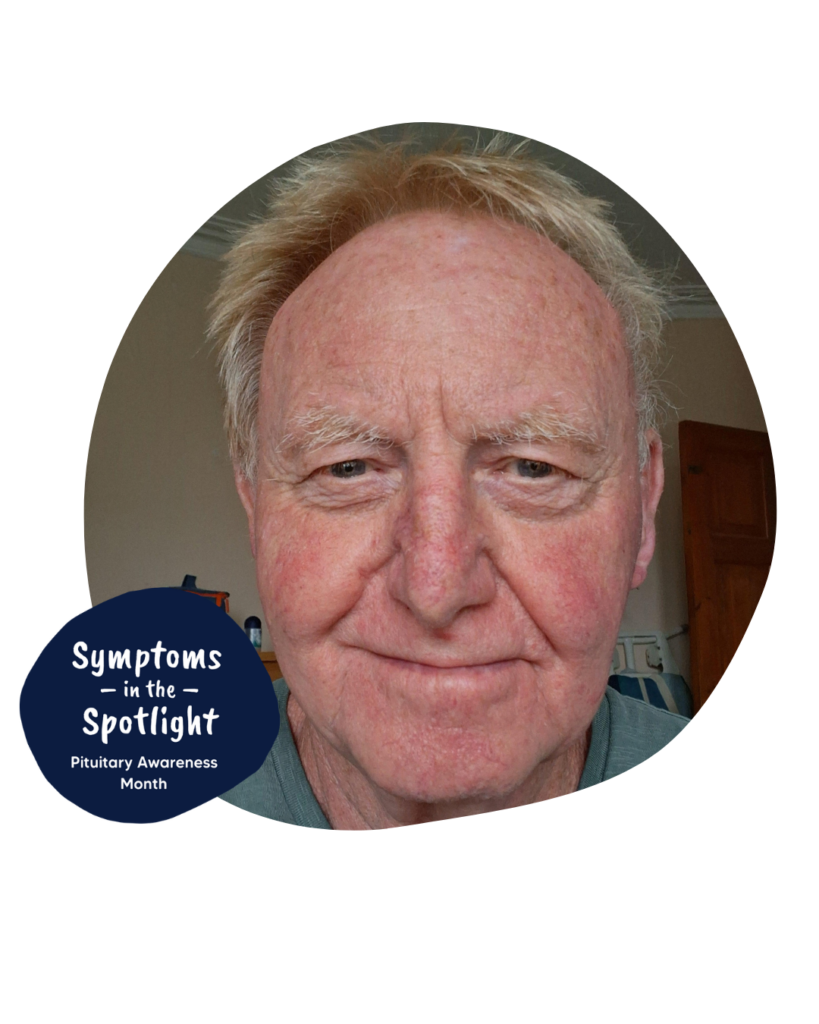
For our Pituitary Awareness Month 2026 campaign, ‘Symptoms in the Spotlight’, Steve shares his story. You can find out more about our campaign and read more of our community’s stories on our website here.
Hello everyone. I’m Steve Taylor, 74 years old and I have hypopituitarism.
My story like so many others, starts with an incident, then a period of incorrect diagnosis, and ends with diagnosis, treatment and recovery.
The incident happened when my wife (Michelle) and I returned from a lovely holiday in Menorca. Two weeks of sunshine, sea swimming and relaxation.
We arrived back in Cardiff and I felt a little groggy. I put that down to the flight and the fuss of travelling. Two days later I went shopping and I remember feeling a little bit spaced out. I had a fuzzy feeling in my head. Later that day, I went to my allotment plot. After being bent over weeding for a long period, I got up and suddenly experienced a massive pain in my head. It felt like someone had hit me with a cricket bat.
After about 30 minutes, the pain lessened and I was able to drive home. I arrived home, I and told Michelle about the head pain and also that I felt too tired to talk. I went to lie down. That was about 5pm. I woke some 7 hours later.
“I went to lie down. That was about 5pm. I woke some 7 hours later.”
The next day, I still felt shattered and my appetite had disappeared. A pattern of sleeping, not eating, nausea and diarrhoea developed over the next few days. I saw my GP and he thought I had something more than a bad headache. He referred me to an emergency day clinic. After 7 hours of tests, the diagnosis was migraine. I’d had a few bouts of visual disturbance migraine in the past. So it was reasonable assumptions that this was another, though more severe episode, with an added headache.
After a couple of days, I suddenly went down hill. I was exhausted, losing weight and unable to think clearly. I don’t recall saying this but Michelle tells me I said “I’m going to die and I want to die”. That was on a Sunday. She and my son got me to see an out of hours Dr. After an brief examination the Dr said she felt a hospital admission was warranted. She asked me if I was OK with that and I said yes but I must admit I couldn’t have cared less.
On admission I was put on a saline drip overnight. At some point I was given a CT scan. I was told it didn’t help with any diagnosis. I’d been in hospital for 4 days and a Dr came to see me. She looked at my notes and asked if anyone had checked my cortisol levels. I couldn’t remember my own name by this time! She arranged for (what I later discovered) a short synacthen test. Following that, another Dr told me I had Addison’s disease. Michelle was visiting me at the time. Neither of us had a clue what that diagnosis meant. I said so and the Dr responded by saying “just take a simple pill each day and you’ll be fine!”
I was give 100mls of hydrocortisone and sometime later a second dose. And indeed I felt hugely better. I was able to move about more freely, the diarrhoea disappeared and my appetite returned.
Eighteen days had passed since I felt the head pain to the Addison’s diagnosis. Then, out of the blue, a nurse asked me if I was ready to go for a CT scan. She said a porter was on his way to take me down to the scanner. I hadn’t been told about this and I was suddenly convinced that the medics suspected cancer (a brain tumour I thought) and they were looking for final proof. Frankly, I found myself shaking and near to tears. When I got to the scanner unit, I begged the radiographer to tell me who had asked for the scan and why. All he could say was that a consultant had ordered a contrast scan and there wasn’t a stated reason. My anxious mind believed that the Addison’s diagnosis was wrong and I had some sort of cancer.
I asked a politely as I could manage (by now I had become angry at the lack of communication) if I could know the result of the scan as soon as possible. To my horror and fuelling my anger further, I was told that it would be at least Monday before the result was known.
Michelle and I spent weekend in dire dread of the outcome. On Monday, I saw the consultant who asked for the scan. He was calm and professional. He explained why he had asked for a contrast scan which would reveal a greater depth of detail. That detail showed that I had an adenoma (a benign tumour) on my pituitary gland. The adenoma had ruptured causing me to have not Addison’s but hypopituitarism.
All that seems like a distant memory now. But as I write this article, I can feel the old anger, anxiety and frustration welling up again. Such is the way with trauma. I have no beef about the incorrect diagnosis. The medical and nursing care I received was excellent. However the poor level of communication skills, are still a source of dissatisfaction. Finding the Pituitary Foundation later on was a great help. Especially when reading the people stories in the magazine. They helped to put it all in perspective.
It’s been nearly three years since my diagnosis. I think I’ve coped well with the medicine regimen. I take 20mg of Hydrocortisone, 75mcg of Thyroxine, 2.5mg of Testosterone and since March this year, a daily injection (via a micro needle) of 0.04mg growth hormone. This latest addition has made a difference. I feel more alert, stronger and happier. Whenever I see my endocrinologist I’m told my blood markers are optimum.
I take 10 mg of Hydrocortisone as soon as I wake (around 6am). I take another 5 around mid-day and 5 around 2.30. I experience fatigue everyday. To combat that I have a daily nap of about 30 minutes. If I could give someone with my condition some advice, it would be to take a regular rest break and if you are not taking growth hormone, ask you endocrinologist about whether you should.
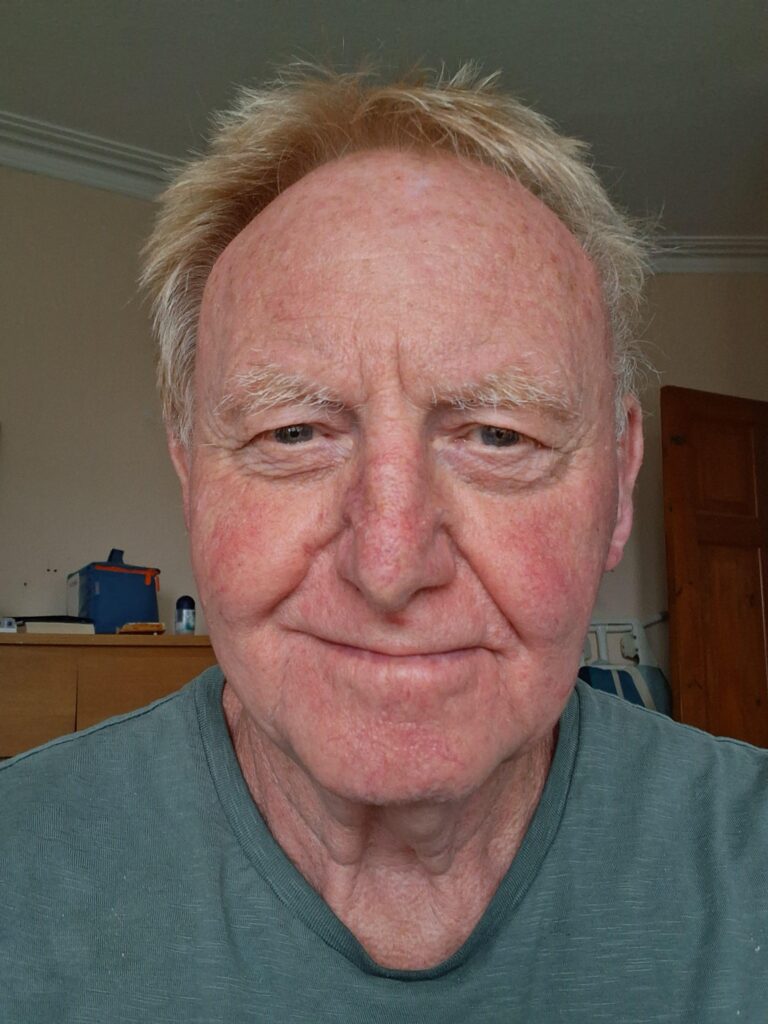
I look well and people (outside my immediate family) would never guess that I have a chronic condition. I wish people generally understood that not all chronic conditions are visible.
“I look well and people (outside my immediate family) would never guess that I have a chronic condition. I wish people generally understood that not all chronic conditions are visible.”
Michelle is a massive support to my well being. If I do have down moments, she’s always there to help me reflect on the positives. Finally, it was the anterior lobe of the gland that was destroyed when the adenoma ruptured. It controls the stimulation / distribution of most of the main hormones, especially cortisol. However the posterior lobe that controls oxytocin and the antidiuretic hormone vasopressin, is still intact.
Most of all I’m lucky to have Michelle in my life. She saw me through the whole, dire, diagnostic period. Without her insistence that I sought medical help and the final intervention of making me see the out of hours Dr, I wouldn’t be here today.
We have a sign up at home saying “You fate is what happens to you; you destiny is what you do about it”.
I believe that to be true. And I will continue to do my best to shape a happy destiny, come what may!
Have you found this helpful?
If so, please support us to bring useful information to more people affected by pituitary conditions.