




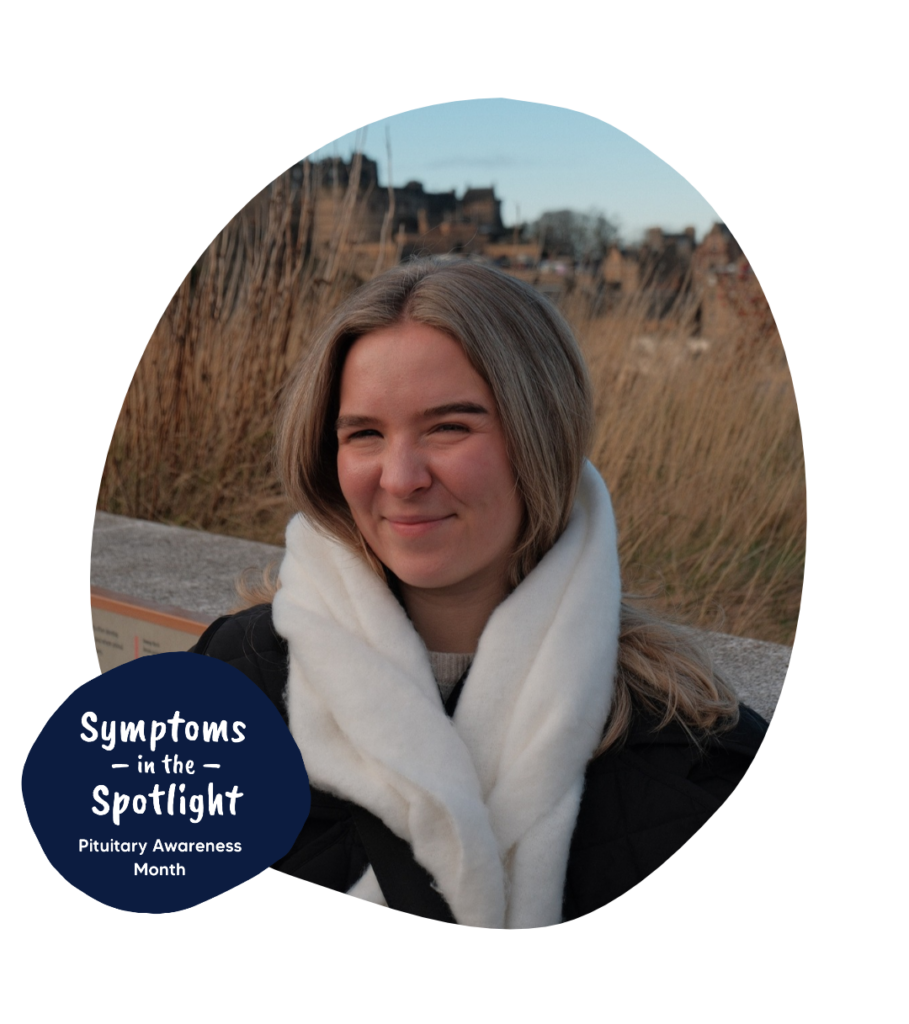
For our Pituitary Awareness Month 2026 campaign, ‘Symptoms in the Spotlight’, Cairenn shares her story. You can find out more about our campaign and read more of our community’s stories on our website here.
Turning 25, I had three fears: getting stuck in a lift, needles, and the thought of ever having to undergo an operation. Getting stuck in a lift should be easy to avoid, but the other two were about to become much more real.
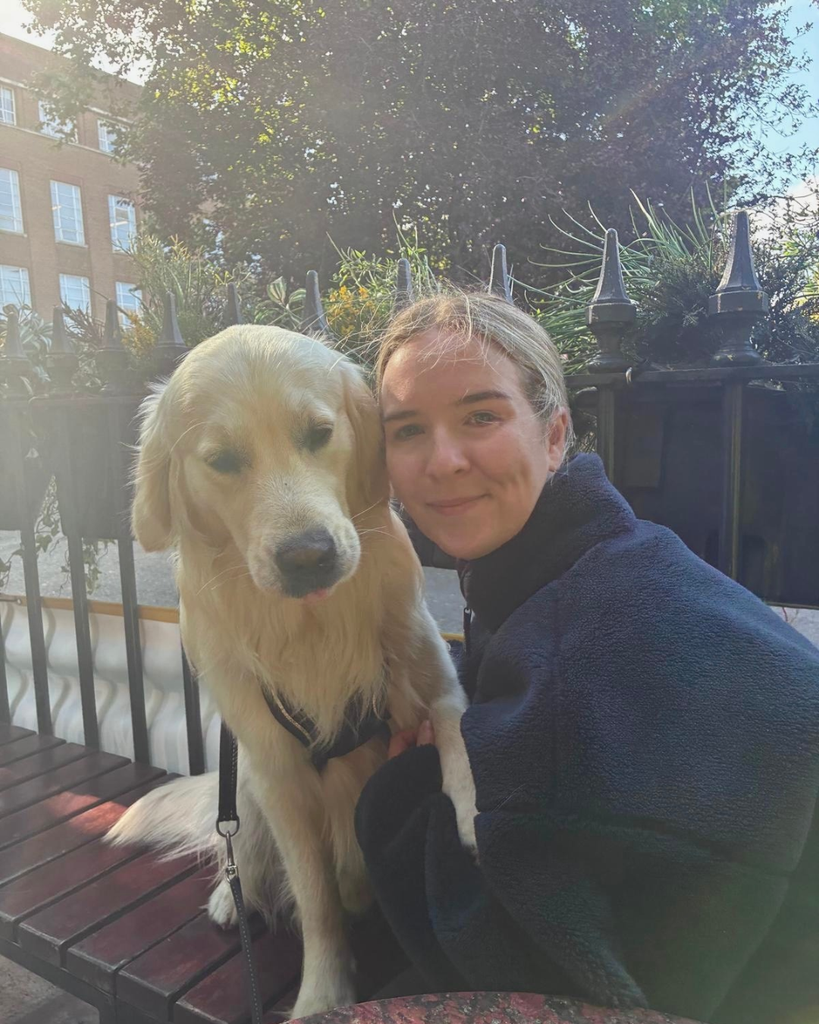
At this point in my life I had been taking the combined contraceptive pill for 13 years. I was originally prescribed it by my GP at the age of 11 for what was described as ‘hormonal acne’.
Around 2023, I started experiencing migraines with aura. During these episodes, I had partial loss of vision, and after a few visits to my GP, I was told to stop taking the combined pill. I was advised to consider alternative forms of contraception, including the copper coil or the implant. After realising just how long I had been taking the contraceptive pill, I decided to give my body a break and wait for my natural cycle to return.
It was at this point that my career took me to the Republic of Ireland. I ended up moving six hours down the road in 2023, living in Cork City while working in Tipperary. With a new job, routine and lifestyle to adjust to, the thought of my periods returning quickly fell to the bottom of my list of priorities as I settled into a new routine. During this time I remember being extremely tired and low energy, but put this down to a long commute for work.
After pushing the thought to the back of my mind for about a year, my mum who happens to be a nurse, encouraged me to contact my GP as she had concerns about the lack of menstrual cycle along with my tiredness. My GP pushed for blood tests to be completed with a focus on prolactin levels. When the results came back, a normal prolactin reading should be between 200-400, my level was over 6,000. An MRI was subsequently ordered and booked for a couple of weeks later. Then, on Christmas Eve 2024, just a week later, my GP called to explain that the MRI had shown a 9×7 mm tumour on my pituitary gland at the base of my brain.
In Northern Ireland, waiting times for endocrinology can be up to 200 weeks. With that in mind and knowing I had a tumour in my brain but with little knowledge about it, I booked a private appointment with an endocrinologist in January, who subsequently moved me over to his NHS care. He started me on cabergoline, which I remained on for just over a year until January 2026.
I was dealing with constant nausea, overwhelming fatigue, numbness in my arms, chest pain, weight loss and a noticeable deterioration in my mood. It felt like I was trying to push through how unwell I felt just to get on with normal life. Although seeing my periods return was a positive sign that the treatment was working, I was struggling day to day.
“It felt like I was trying to push through how unwell I felt just to get on with normal life.”
I relied heavily on the experience of others shared by The Pituitary Foundation during this time and truly believe that my doing my own research on the disease, and reading others stories, helped to shape my outcome.
At my yearly review with my endocrinologist in January of this year, I asked to be referred to a neurosurgeon. I had gave the medication a chance and worried about the long term impact this would have on my life. I found from research that cabergoline can normalise prolactin but when coming of it, it can again rise and has a very small remission rate. I was advised that medication is the first-line treatment for prolactinomas and that a neurosurgeon would not touch my case unless I wanted to have children within the next couple of years.
By this point, I was 26 and at a really important stage in my life, both career-wise and personally. I wanted to feel well enough to work, make long-term decisions, and although having children was not something I wanted within the next couple of years, I found it frustrating that surgery seemed to be presented as an option only if my plans for having children changed.
One of the hardest parts of this experience was knowing that I wasn’t asking for an easy option, in fact I was asking for something that I feared the most. I was asking for brain surgery because the alternative was continuing with a treatment that was affecting my life and would do so for the rest of it had I stuck with the conventional treatment approach, despite emerging research suggesting that surgery can be considered as a first-line option for young females in similar positions.
After some pushing from myself, my mum & my GP, three months later in April of this year, I was accepted into the care of my neurosurgeon.
It began to become clear that this had been the right decision when my first MRI after a year of cabergoline treatment showed that the tumour had actually grown and was beginning to extend towards the major blood vessel running alongside my pituitary gland.
Over the following months, my surgery was planned, and on August 5th this year, I had the tumour successfully removed. My prolactin levels had returned to normal by the following morning. I stayed in hospital for five nights, which I found really tough, but the scans led us to believe that everything had gone to plan.
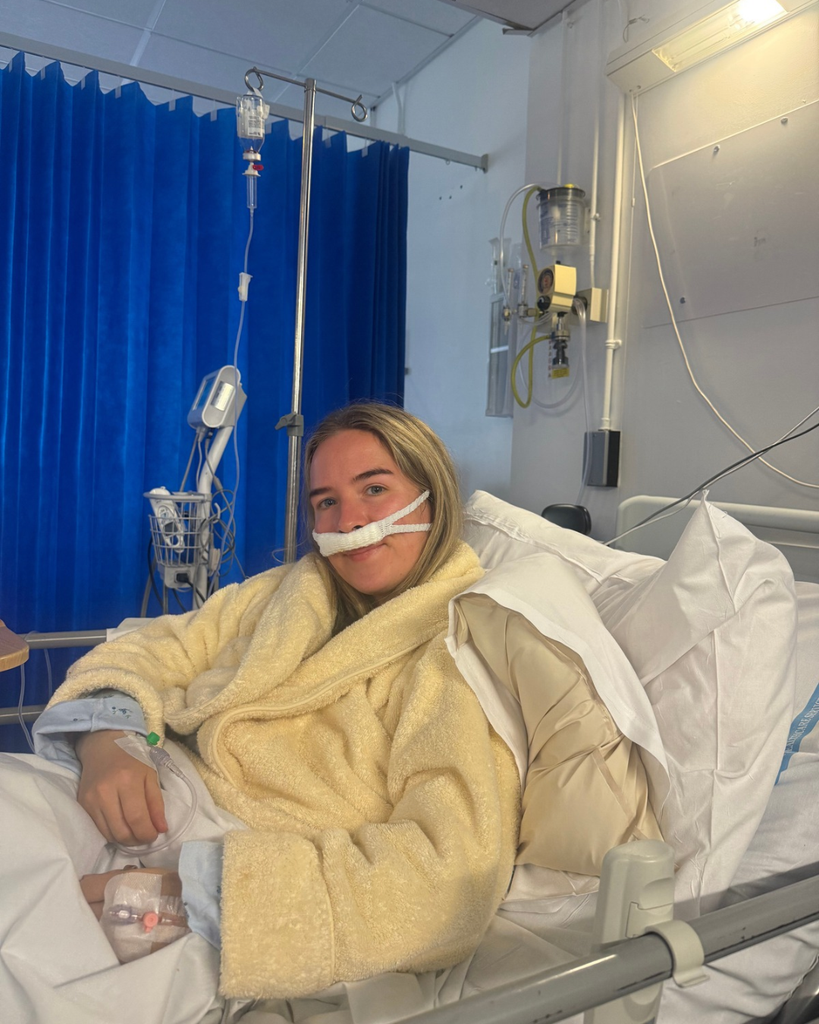
I’m now nearly six weeks post-op. I’m slowly starting to get some of my energy back, although recovery hasn’t been completely straightforward. I’ve lost my sense of smell and taste, as well as the sensation in my teeth, and I still experience headaches, nausea and some dizziness. Thankfully, the headaches are manageable, and my menstrual cycle has returned to normal without needing any medication. After almost two years of blood tests, medication, symptoms, appointments, scans and the uncertainty of what was going to happen next, I’m finally at a point where I can start looking forward again.
It’s strange being on the other side of something that has taken up so much of my life. I know I’ll probably always have some anxiety about whether the tumour could grow back, and I don’t think I’ll ever completely forget everything that has happened. I’m still in the middle of the story rather than completely at the end of it. But for the first time since Christmas Eve 2024, I feel like I can start thinking about what comes next.
“I’m still in the middle of the story rather than completely at the end of it. But for the first time since Christmas Eve 2024, I feel like I can start thinking about what comes next.”
I truly believe that doing my own research, asking questions and pushing to find the right consultant helped change the outcome of my story. I’ll always be grateful to my surgeon, who didn’t just see my age or my circumstances. He saw me as a 26-year-old with my whole life ahead of me, and understood that feeling well and being able to get on with that life mattered too.
For the first time in nearly two years, I’m not planning my life around a tumour. And that, more than anything, is what I’m most grateful for.
Have you found this helpful?
If so, please support us to bring useful information to more people affected by pituitary conditions.