





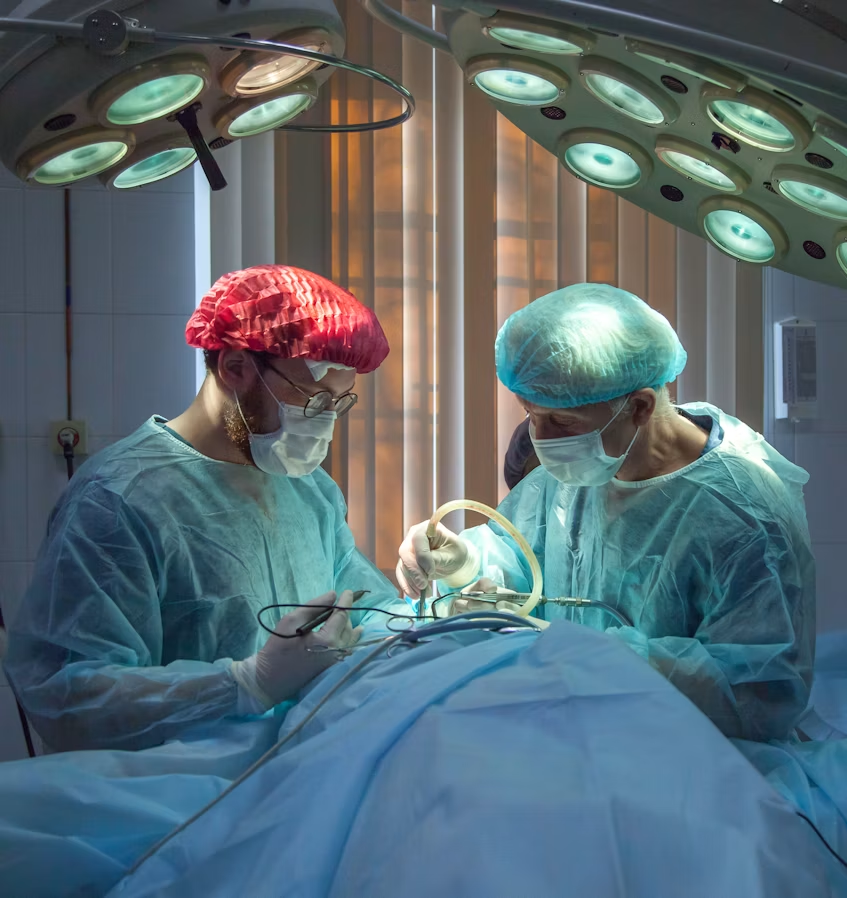
Minimally invasive surgery has transformed the way many pituitary tumours are treated. Instead of large openings, surgeons can now often operate through small, carefully planned corridors, commonly through the nose, allowing access to the pituitary gland while minimising disruption to surrounding brain structures. For patients, this approach is associated with reduced complications, less post-operative discomfort, and faster recovery. It represents a significant step forward in neurosurgical care. However, these advances come with an important technical challenge.
When operating through narrow anatomical pathways, surgeons are required to work deep within the skull using long, straight instruments. These tools have changed little over the past decades and lack the ability to bend or articulate. As a result, surgeons lose triangulation, the ability to approach tissue from multiple angles, which is essential for precise manipulation. This challenge has sometimes been described as operating with chopsticks in a matchbox. This makes delicate tasks, such as tumour dissection near critical structures, more difficult, even in experienced hands.

The role of robots in surgery
Robotic technology has offered solutions in other surgical fields by improving dexterity and precision. Yet, most existing robotic systems are large, console-based robots, and designed for procedures in the abdomen or pelvis. Their size and structure make them unsuitable for the confined spaces of the skull base, and they have therefore not been widely adopted in pituitary surgery.
To address this gap, a different type of robotic system has been developed: a handheld platform designed specifically for minimally invasive neurosurgery. Rather than replacing the surgeon, this device is intended to enhance their capabilities. It is small enough to operate within narrow surgical corridors, while incorporating articulated, wrist-like movement at its tip. This allows for improved dexterity and more precise tissue manipulation at depth. These are capabilities that are difficult to achieve with conventional rigid instruments.
Crucially, the system is designed to integrate seamlessly into existing surgical workflows. The surgeon remains at the bedside and maintains direct control of the instrument at all times. In this way, the technology aims to preserve the familiarity and responsiveness of traditional surgical techniques, while extending what is technically possible within a minimally invasive approach.
From studies to surgery: How this technology is developing
Early-stage studies have demonstrated promising results. The device has been evaluated across laboratory, cadaveric, and animal models, where it has been shown to be safe and feasible. Surgeons reported improved workspace reach and enhanced control when operating in confined spaces, particularly in the approaches through the nose that are commonly used for pituitary surgery. At the same time, these studies have highlighted areas for further refinement, and the technology continues to undergo iterative development.
Looking ahead, the potential impact of such a system lies in its ability to expand the scope of minimally invasive neurosurgery. By improving access and precision within narrow corridors, it may enable a greater number of procedures to be performed using less invasive techniques. For patients, this could translate into safer operations and improved recovery, while maintaining the high standards of surgical effectiveness required in treating complex brain conditions.
The development of this handheld robotic platform reflects a broader shift in surgical innovation, not only making procedures less invasive, but also ensuring that surgeons are better equipped to perform them.
At the time of writing (April 2026), ongoing work is also focused on understanding how patients and the wider public perceive these emerging technologies, including their expectations, concerns, and willingness to accept robotic assistance in minimally invasive brain surgery. We welcome readers to complete this survey to tell us what you think.
This article was originally written for our member’s magazine, Pituitary Life. To get priority access to more content like this, become a member today to receive Pituitary Life.
Have you found this helpful?
If so, please support us to bring useful information to more people affected by pituitary conditions.